
Influencer Rate Calculator
Use this free Influencer Rate Calculator to estimate a starting price for an Instagram, TikTok or YouTube collaboration. The estimate considers the creator’s audience size, engagement rate, content format, advertising usage rights and exclusivity.
Enter the campaign details below to generate a starting fee range. Use the result for early budget planning and negotiations rather than as a guaranteed final price. Your entries stay on your device and are not stored by Cultures Connect.
This is a planning estimate, not a guaranteed market rate. Final fees vary by country, niche, production work, audience quality, licensing, and negotiation.
How to Use the Influencer Rate Calculator
Follow these steps to estimate an influencer collaboration fee:
- Select the social media platform.
- Enter the creator’s current follower count.
- Add their average engagement rate.
- Choose the required content format.
- Select whether the brand needs paid advertising usage rights.
- Select whether the agreement includes 30-day category exclusivity.
- Choose Estimate collaboration rate to generate a starting range.
If you do not know the creator’s average engagement rate, use the free Influencer Engagement Rate Calculator first.
How Influencer Pricing Works
There is no universal price that every influencer should charge. Two creators with the same follower count can have very different rates because their audiences, content and campaign requirements are different.
Follower count provides a starting point, but it does not show the full value of a collaboration. A creator with a smaller but highly relevant audience may charge more than a larger creator with weaker engagement or a less specialised audience.
The final price may also depend on the time needed to develop the concept, film the content, edit it, respond to feedback and publish it.
This Influencer Rate Calculator combines several common pricing factors to create a broad starting range. It does not replace a personalised quotation from the creator or their management team.
Factors That Affect Influencer Rates
Social Media Platform
Production requirements differ across Instagram, TikTok and YouTube.
A static Instagram post may require photography and editing. A Reel or TikTok video may involve scripting, filming, voice-over work and several rounds of editing. A dedicated YouTube video usually requires more production time and can remain discoverable for longer.
Follower Count
A larger following can increase a creator’s potential reach. However, followers should not be treated as the only measure of value.
Check whether the audience is genuine, active and relevant to the brand. Audience location, age, interests and purchasing power can be more important than the total number of followers.
Engagement Rate
Engagement rate shows how actively people interact with the creator’s content. Likes, comments, shares and saves can provide useful context about audience interest.
Make sure you compare creators using the same calculation method. A follower-based engagement rate should not be compared directly with a reach-based rate.
Content Format
A Story set normally requires less production than a carefully edited short-form video. A dedicated YouTube video may require research, filming, editing, thumbnails and a longer integration.
The rate should reflect the work required, not only the final duration of the content.
Paid Advertising Usage Rights
A standard creator fee usually covers content production and organic publication on the creator’s account. It does not automatically give the brand unlimited permission to use that content in advertising.
If a brand wants to promote the creator’s post as an advertisement, the agreement should specify the platforms, duration, countries and permitted uses. Meta explains that creators can give advertisers permission to promote individual posts, Stories or Reels through partnership-ad permissions.
Paid usage rights should normally increase the creator’s fee because the brand receives additional commercial value from the content.
Category Exclusivity
Exclusivity prevents the creator from working with competing brands for an agreed period.
For example, a skincare brand may request that the creator does not promote another skincare company for 30 days. This limits the creator’s opportunity to accept other paid work, so exclusivity should be reflected in the price.
The category, countries and start and end dates should be written clearly in the agreement.
Example Influencer Rate Estimate
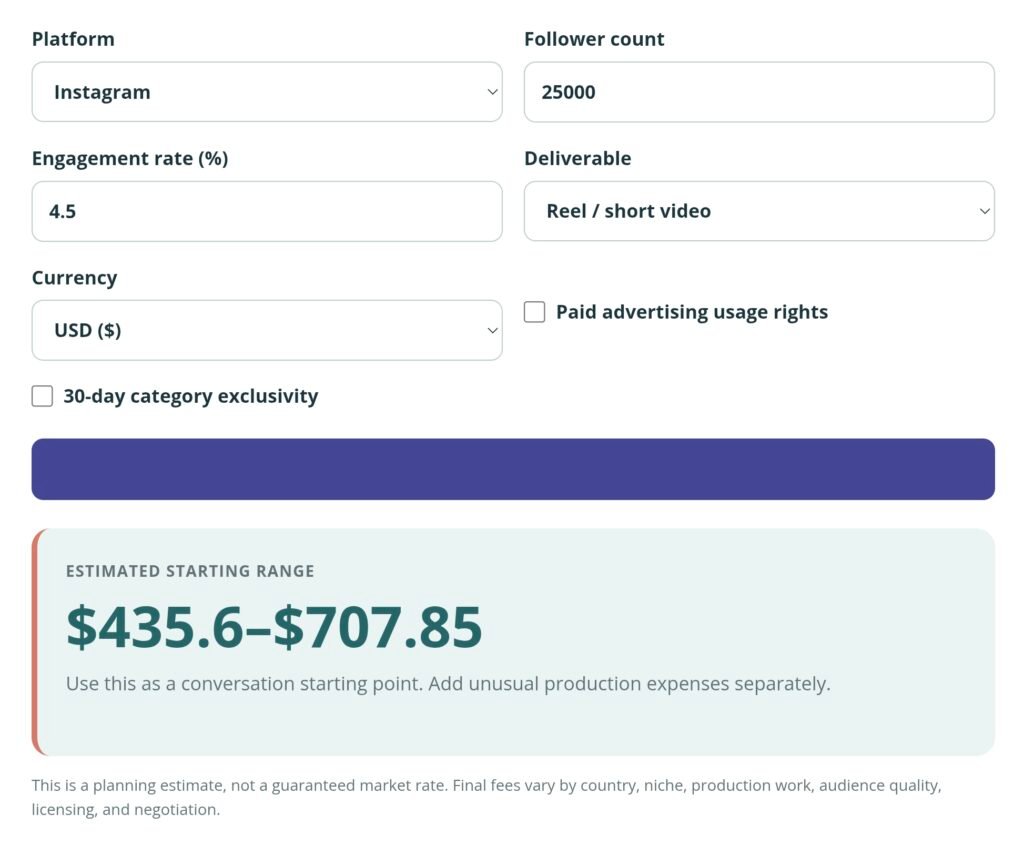
Imagine that a brand wants to work with an Instagram creator who has:
- 25,000 followers
- A 4.5% engagement rate
- One Reel or short-form video
- No paid advertising usage rights
- No category exclusivity
Using these details, the calculator will produce an estimated starting range in USD.
This result can help the brand set an initial budget or begin a conversation with the creator. The final quotation may be higher or lower depending on the creator’s niche, audience quality, location, production requirements and previous campaign results.
If the brand later requests advertising rights or exclusivity, calculate the estimate again with those options selected.
What Should an Influencer Collaboration Include?
Before agreeing on a price, the brand and creator should confirm:
- The number and type of deliverables
- The required platform
- The campaign message
- Key talking points
- Content deadlines
- Publication dates
- The number of revisions
- Approval responsibilities
- Usage rights
- Usage duration
- Category exclusivity
- Reporting requirements
- Payment amount and schedule
- Cancellation terms
- Disclosure requirements
A clear agreement helps prevent additional requests from being added after the price has already been accepted.
Common Influencer-Pricing Mistakes
Pricing by Followers Alone
Followers show potential reach, not guaranteed attention or sales. Review audience relevance and engagement before agreeing on a price.
Leaving Usage Rights Unclear
Posting content on a creator’s account is different from giving the brand permission to use that content in paid advertising, emails, websites or other campaigns.
Specify exactly where and how long the brand can use the content.
Offering Only Free Products
A free product may be suitable for an unpaid gifting arrangement, but gifting does not guarantee that the creator will publish content. If the brand requires specific deliverables, deadlines or approvals, a paid agreement is usually clearer.
Requesting Unlimited Revisions
Unlimited revisions can turn a simple collaboration into a much larger project. Agree on the number of included revisions before production begins.
Ignoring Production Costs
Travel, locations, props, models and specialist editing may need to be charged separately. The calculator does not include unusual production expenses.
Forgetting Advertising Disclosure
Paid collaborations and other material brand relationships should be disclosed clearly. The FTC’s guidance for social media influencers explains that financial relationships, free products and other material connections may require disclosure when the content could affect US consumers.
Creators and brands should also check the rules that apply in their own countries.
Frequently Asked Questions
How much should an influencer charge per post?
There is no fixed rate for every post. The price depends on the platform, audience size, engagement, content format, production work, niche, usage rights and exclusivity.
Use the calculator’s result as a starting range, then adjust it according to the full campaign brief.
Can brands use this calculator?
Yes. Brands and agencies can use it for early campaign planning, creator shortlisting and budget discussions. It should not be treated as a compulsory rate.
Can creators use this calculator?
Yes. Creators can use the estimate as one reference when preparing a quotation. They should also consider their experience, production time, audience quality and the commercial rights requested by the brand.
Why does engagement rate affect the estimate?
A strong engagement rate can indicate that the audience actively responds to the creator’s content. This may make the partnership more valuable, especially when the audience is relevant to the brand.
Are Stories usually cheaper than Reels?
Stories often require less production than edited short-form videos, but this is not always the case. The number of Story frames, creative requirements, links and usage rights can affect the final price.
What are paid advertising usage rights?
Paid advertising usage rights allow a brand to use or promote the creator’s content in advertising. The agreement should define the platform, duration, location and permitted use.
What does 30-day category exclusivity mean?
It means the creator agrees not to promote specified competitors within the agreed category for 30 days. The exact category and dates should be included in the contract.
Does the estimate include production expenses?
No. Unusual expenses such as travel, venue hire, props, models or specialist editing should be discussed and added separately.
Is the estimated rate guaranteed?
No. It is a planning estimate. The creator and brand remain free to negotiate a fee based on the complete campaign requirements.
Does Cultures Connect store my information?
No. The calculation happens on your device. Cultures Connect does not store the information you enter.
Plan Your Influencer Campaign
After estimating the creator’s fee, use the Social Media Campaign Budget Calculator to plan the rest of the campaign costs, including content production and paid promotion.
You can also read our guide on how to leverage influencers for a successful campaign for help with creator selection, briefing and measurement.
For more resources, explore the Cultures Connect marketing tools or download The Pop Culture → Brand Strategy Playbook.